US
US NZ
NZ UK
UK SG
SG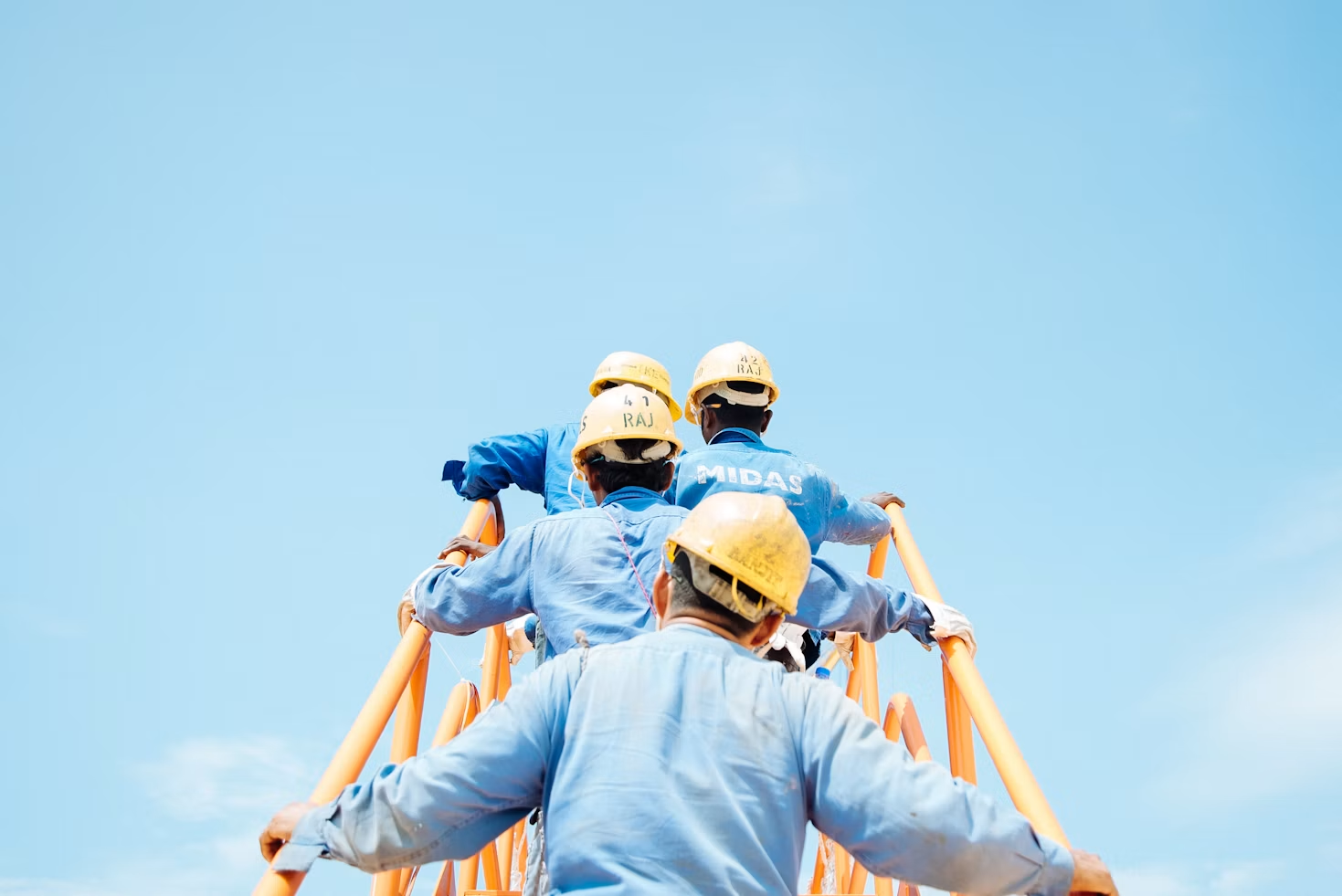
That doesn’t mean frontline workers don’t notice these hazards. More often, the issue is that reporting can be harder than it needs to be. Potential risks go unreported, and environment, health, and safety (EHS) teams can’t see the full picture.
That visibility matters. In 2023–24, 146,700 serious workers’ compensation claims were made in Australia, according to Safe Work Australia. That’s more than 400 serious claims every single day.
For EHS teams, one of the hardest parts of managing risk is knowing what’s actually happening on the ground. Without that knowledge, emerging hazards can go unchecked, and opportunities to intervene early can be missed.
That is where effective near-miss reporting software can make a significant impact. It offers straightforward, easy-to-use templates and photo and video upload capabilities, making it easy for organisations to incorporate reporting into everyday workflows. Plus, it improves transparency and demonstrates that reporting from frontline workers turns into action for EHS teams.
In this guide, we’ll cover what drives adoption, what makes reporting easy and accessible for frontline workers, and what to consider when comparing platforms.
Key takeaways
- Near-miss reporting gives EHS teams an early warning sign of risks that may otherwise go unnoticed or unreported
- Effective near-miss reporting software removes the practical and behavioural barriers to reporting
- Connecting near-miss reports to wider safety data helps EHS teams identify recurring hazards and emerging risks across sites, turning those reports into proactive insights
Why near-miss reporting often stalls in practice
Near-miss reporting serves a different purpose from standard incident reporting. Where incident reports tell you what’s gone wrong, near-miss reports show you where something could go wrong next.
This data provides valuable indicators that help safety teams identify emerging risks before an incident happens.
Let’s say a frontline worker notices a loose cable on the ground, nearly trips over it, and then carries on with their shift. They plan to report it, but by the time they get back to a computer to log in and fill out a form, the moment has passed, and they’ve forgotten about it.
This scenario is one of the biggest challenges safety teams face when it comes to near-miss reporting. And, unlike an injury, a near miss often doesn’t feel as urgent to the person who experiences it.
Add in complex reporting processes that don’t keep workers informed, and the whole workflow can seem unnecessarily difficult and time-consuming. It’s easy to see why many of these early warning signs might go unrecorded.
Some common barriers to reporting near misses include:
- Reporting that takes too long: Lengthy forms and irrelevant questions make workers feel less inclined to report the next near miss they come across.
- Workers who aren’t sure what qualifies as a near miss: An injury is a straightforward incident. A close call can be harder to identify as something worth reporting.
- Reporting that requires access to a desktop: If your frontline workers need to leave their worksite or wait until they’re back at a desk to report the incident, they might miss important details or forget to file a report altogether.
- Poor connectivity that makes reporting impractical: On remote or high-risk sites, unreliable internet can hamper efforts to submit a report when a near miss happens.
- Workers who don’t see any outcomes from uploading a report: If reports disappear into a system and there’s no visible follow-up or way to track actions, workers have less incentive to spend time submitting another report.
These barriers create issues that go beyond reporting rates. Every unreported near miss is a key piece of data that safety teams can’t analyse to increase safety across the organisation.
An effective incident reporting software removes these barriers to reporting, helping teams capture reports consistently, structure the data, and connect it with wider safety information to turn insights into action.
5 safety software capabilities that strengthen near-miss reporting
When evaluating near-miss reporting software, look for a platform that addresses and solves for the barriers that stop frontline workers from reporting near misses in the first place.
Look for these five capabilities to help make safety reporting easy, accessible, and worthwhile for frontline workers while giving EHS teams tools to turn those insights into action.
1. Make it possible to file reports where the work happens
Capabilities: Mobile access and offline capture
Frontline staff shouldn’t be expected to retain key details and remember to report a near-miss event when they finally get back to a desk. Mobile reporting capabilities solve that problem, allowing them to submit information immediately, while the event is still fresh in their mind.
For construction and mining organisations with remote sites, where internet connection might be spotty or unavailable, the option for frontline workers to report any near-misses offline and sync it later removes a major practical barrier.
2. Make forms customisable for each site
Capability: Simplified, configurable forms
Your near-miss submission forms should reflect the realities of each job site, and they shouldn’t feel like a burden for your workers to complete. Look for reporting software that lets you customise forms to suit different sites and risk profiles. That way, you’re only capturing the information necessary for analysis and potential action.
This makes it faster and easier for frontline workers to report incidents, and it reduces the data that EHS teams need to sift through.
Find a platform that offers no-code, configurable modules that help safety teams customise forms themselves, without needing vendor or developer support.
3. Give workers appropriate reporting options
Capability: Anonymous or confidential reporting
For some frontline workers, the biggest barrier to reporting a near miss is often the concern that speaking up could lead to blame or repercussions. Providing anonymous or confidential reporting options gives workers another way to share safety concerns when they don’t feel comfortable identifying themselves.
Anonymity shouldn’t be treated as a substitute for a strong near-miss reporting culture at your organisation, though. EHS teams also need to create an environment where workers feel safe and supported in raising concerns openly, knowing that reports will be used to improve conditions, not take action against the workforce.
The best near-miss reporting platform should offer frontline workers different reporting options and give EHS teams the flexibility to choose an approach that works for their organisation.
4. Close the feedback loop so workers know that reporting leads to action
Capability: Automated workflows, corrective-action tracking, notifications
One of the biggest barriers to near-miss reporting is that frontline workers often wonder whether their reports go unnoticed.
Let’s say a worker records a near-miss incident in the designated spreadsheet but doesn’t see anyone acting on the report. If they’re left to assume that no one saw the report or that it was ignored, they’ll be less likely to report the next time they encounter a near-miss situation.
Now, let’s say there’s a clear corrective-action tracking process in place at their organisation. When that worker reports a near-miss incident, their submission is acknowledged as part of an automated process for reporting, necessary corrective action is assigned, and the status of the action is trackable until completion.
When workers see that their actions have positive knock-on effects, it can foster a culture of regular near-miss reporting. Look for platforms that offer corrective actions modules that help organisations manage corrective and preventative actions (CAPA), along with the ability to automate workflows that ensure notifications are sent, actions are tracked, and nothing falls through the cracks.
5. Turn near-miss data into better safety outcomes
Capability: Real-time dashboards
Gathering near-miss reporting data is one thing. Being able to analyse all of it in one place to know what it’s indicating about underlying risks is another.
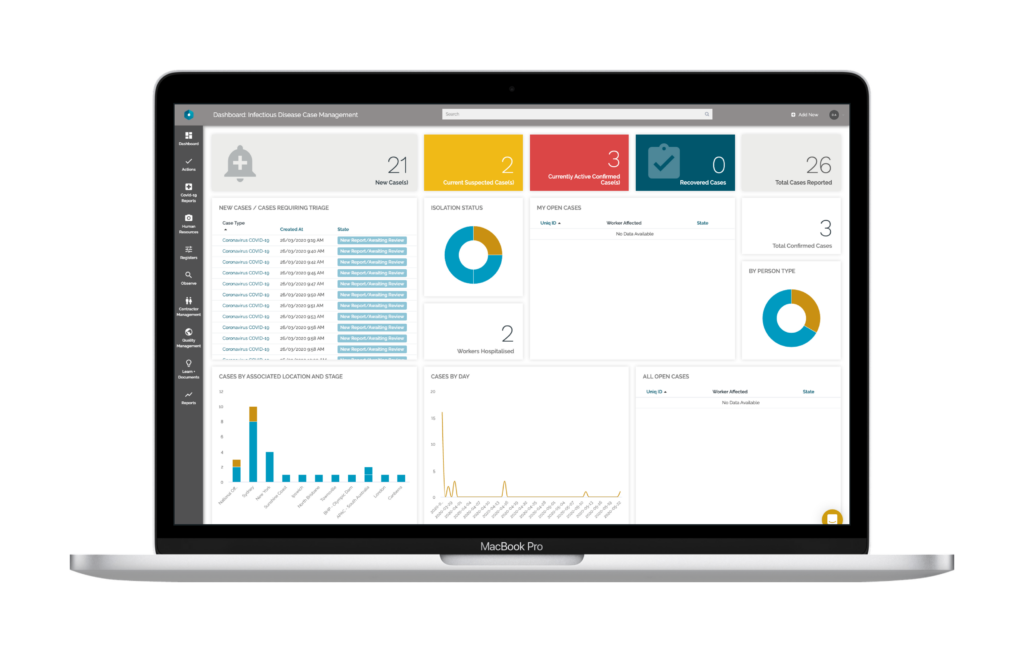
Look for hazard reporting platforms that help EHS teams aggregate data and spot patterns or changes in near-miss reporting volumes, locations, departments, or other categories relevant to your organisation.
With EHS platform Donesafe, an organisation’s entire safety data is stored in a central platform that updates in real time, and it gives teams the ability to create custom dashboards so they can analyse data across different sites and entities.
This lets teams make data-driven safety decisions about what to investigate, how to take action, or how to allocate resources.
How near-miss data reveals emerging risks
An increase in near-miss reporting can be concerning for an organisation, which may assume it’s a sign that safety is declining. EHS teams need to understand what’s driving the change. It could reflect a stronger reporting culture or a genuine increase in underlying risk (or a combination of both).
A safety management platform should give teams enough context to distinguish between these factors. For example, if near-miss reports increase at one site, teams can use a connected EHS platform like Donesafe to investigate what types of issues are being reported, where they’re happening, whether similar issues are showing up in other sites, and whether corrective action has been taken.
This makes near-miss data a valuable piece of the puzzle, giving EHS teams the context they need to take action before those near misses become real risks. Finding a near-miss reporting platform that can fit into your existing workflows makes it even more valuable.
Here are some ways EHS teams can use near-miss reporting software to turn raw data into useful leading indicators:
- Categorise reports consistently to identify trends across common hazard types
- Identify recurring hazards to see whether they indicate a systemic risk
- Compare sites, teams and tasks to identify locations with higher levels of near misses
- Connect near misses with hazards or risk registers to see where identified risks are potentially turning into hazards
- Link reports to corrective actions to track whether near misses are being addressed
- Track trends over time to see whether risk patterns are changing
- Use role-tailored dashboards to give site managers and EHS teams information relevant to their responsibilities
Questions to ask when comparing near-miss reporting software
Knowing what capabilities to look for in a platform is one thing. Knowing how it would work in your organisation’s workflow is another thing entirely.
Before choosing a platform, inquire about the software’s capabilities beyond the feature list. Ask vendors questions that will help you understand how the software would work for your organisation. Here are a few to consider:
What to ask when evaluating near-miss reporting software
| Question to ask | What their answer will tell you |
|---|---|
| Can workers report wherever work happens? | Whether the platform supports mobile reporting, offline capture, and a user experience that works for frontline teams |
| Can we customise reporting forms without code? | How easily modules and forms can be customised and adapted for different sites, entities, and risk profiles without relying on vendor support |
| What happens after a near miss is reported? | Whether EHS teams can automate workflows, including assigning corrective actions and sending notifications to maintain accountability |
| Can we see trends across the organisation? | Whether you can configure a dashboard to analyse data and identify trends and emerging risks |
| Can near-miss data connect with our wider safety data? | Whether near-miss data can be connected to risk registers and corrective actions to give EHS teams greater visibility on risks at the organisation |
| How easily can we get the workforce to start using it? | Whether the platform is intuitive to use and easy to implement |
| Can the platform scale as we add new sites or employees? | Whether the system can adapt to add more tasks, sites, and users without becoming unmanageable |
How P4G Security boosted reporting numbers with Donesafe
Security service provider P4G Security has a team that works across a range of risk environments. In the past, its safety information and reporting practices were spread across multiple spreadsheets, making it hard to investigate trends or review historical incidents.
The company turned to Donesafe to make reporting easy enough that its frontline staff could do it, even during busy or stressful shifts.
With Donesafe, P4G Security now uses QR codes and mobile phones to help its security guards submit incident reports and attach any photos from the scene instantly, right where it happened. Incident reports are no longer delayed until the end of a shift.
Within six months of using Donesafe, P4G Security’s safety team had gathered enough safety data to spot a pattern that they hadn’t noticed before: Knife-related incidents were happening at similar times each week, often after 2 pm on Thursdays and Fridays.
With this insight, along with feedback from security guards, the company adjusted their staffing levels and provided additional support during those higher-risk periods to better protect their team.
Stephanie Watts, Manager, Health & Safety at P4G Security, says this valuable insight wouldn’t have been possible if her frontline team hadn’t felt comfortable enough to report incidents through Donesafe.
“Being able to show them that I can use it helped them use the program too; it wasn’t just something I pushed onto them,” Stephanie says. “I didn’t even care what they reported—even if it was a duck crossing the road. I told them to report whatever they felt like because that builds a culture of providing a safe network.”
With Donesafe, P4G Security can now spot issues early, discover trends, and use these insights to improve the safety of its staff on the ground.
Make near-miss reporting part of your proactive safety management
When you make reporting easy, your frontline staff is more likely to speak up about close calls when they happen, and your EHS teams can take action to prevent them from becoming serious risks in the future.
Effective near-miss reporting platforms give teams the ability to route reports automatically, track corrective actions, and connect near-miss data with wider safety information, creating a continuous feedback loop that a workforce can trust. Workers report a near miss, teams act on it, and EHS leaders use this data to identify further preventative action.
If you’d like to know more about how configurable reporting, automated workflows, and connected safety data can support a more proactive culture of risk management, book a demo with Donesafe.
FAQs
How can safety software increase near-miss reporting?
Safety software can reduce practical barriers that stop workers from reporting near misses. Mobile access, simple forms, and photo uploads make it easier to make reports at the point of the potential hazard. Transparent corrective-action tracking can also help reinforce reporting behaviour by showing workers that the organisation takes action when it receives reports.
What should you look for when choosing near-miss reporting software?
When choosing near-miss reporting software, look for a platform that is accessible for frontline workers to use where the near miss happened and includes corrective-action tracking, automated workflows, and connected safety data that can be analysed through easy-to-configure dashboards.
How can you get workers to adopt near-miss reporting software?
You can get workers to adopt near-miss reporting software by making reporting as easy as possible. Find a platform with an intuitive user interface, configurable forms that only capture relevant information, and visibility into what happens after they submit a near-miss report.
Share: