US
US NZ
NZ UK
UK SG
SG
With Australians filing 146,700 serious workers’ compensation claims in 2023–2024, equivalent to more than 400 claims a day, selecting the best EHS software is about more than meeting compliance obligations. It’s about spotting risks earlier and preventing them to keep your workforce safe.
Both Donesafe and WHS Monitor are top-tier options for workplace health and safety software, so the ‘right’ choice depends on what your organisation values most. For example, do you need to hit the ground running with turnkey compliance reports? Or is a configurable platform that gives your team maximum autonomy a better fit?
Donesafe’s environment, health, and safety (EHS) ecosystem lets internal admins freely modify or customise forms and fields and embed smart field logic with a no-code, drag-and-drop setup that doesn’t require developer input.
WHS Monitor, meanwhile, takes a more disciplined approach, offering a template-driven environment built as an ISO 45001 compliance tool that is aligned with ISO frameworks and Australian WHS legislation.
In this comparison article, we’ve evaluated both platforms across six core categories, diving into their operational friction points and strengths, as well as areas of differentiation to help you determine which is more likely to meet your organisation’s needs.
Key takeaways
- Donesafe offers flexibility and autonomy, making it great for multi-site corporations with complex needs
- WHS Monitor offers more out-of-the-box structure and compliance, making it great for APAC industries needing rigid legislative alignment
- Donesafe requires upfront configuration mapping in the short term, whereas WHS Monitor’s template environment speeds up implementation
- WHS Monitor lacks out-of-the-box ESG dashboard capabilities, whereas Donesafe is equipped with dedicated modules to satisfy corporate sustainability requirements
- Both platforms offer enterprise-grade cloud security
In this guide, we’ll cover:
- Donesafe vs. WHS Monitor setup comparison
- Donesafe vs. WHS Monitor: How we evaluated each platform
- Donesafe vs. WHS Monitor: A head-to-head comparison
- The final verdict: Why Donesafe is the platform of choice
- FAQs
Donesafe vs. WHS Monitor setup comparison
Here’s a quick summary overview of the Donesafe and WHS Monitor platforms.
Donesafe vs. WHS Monitor at a glance
| **Category** | **Donesafe** | **WHS Monitor** |
|---|---|---|
| USP | Highly configurable platform that adapts to complex organisations’ needs | High compliance platform that delivers on prescriptive workplace health and safety frameworks |
| Pricing | Enterprise tier | Mid-market to enterprise tier |
| Implementation speed | Moderate | Rapid |
| Configuration model | In-house self-service | Template-driven |
Donesafe vs. WHS Monitor: How we evaluated each platform
To compare Donessafe and WHS Monitor, we evaluated the platforms across six categories:
- Reporting and hazards
- Inspections and checklists
- Risk, environmental, and asset protection
- Training, competency, and contractor management
- Flexibility, integration, and no-code systems governance
- Visual dashboards, BI analytics, and real value
Within each category, we assigned each platform an overall rating from 0–4, based on the platform’s technical ceiling and overall design style.
Consider the distinctions between the top two ratings:
- A platform with a level 4 rating offers organisations complete, code-free control to change the systems and set up independently, or include smart tools such as predictive AI.
- A platform with a level 3 rating automatically shares data across different modules smoothly, but it needs vendor tech support to make big, structural changes.
Overall rating of Donesafe and WHS Monitor platforms across six categories
| **Category** | **Donesafe** | **WHS Monitor** |
|---|---|---|
| Reporting and hazards | 4 | 3 |
| Inspections and checklists | 4 | 3 |
| Risk, environmental, and asset protection | 4 | 2 |
| Training, competency, and contractor management | 4 | 3 |
| Flexibility, integration, and no-code systems governance | 4 | 3 |
| Visual dashboards, BI analytics, and real value | 4 | 4 |
| **Overall score** | **4/4** | **3/4** |
Donesafe vs. WHS Monitor: A head-to-head comparison
Now that you know how each platform scores overall, let’s dive a little deeper to see how Donesafe and WHS Monitor differ across each category.
1. Reporting and hazards
The way an EHS platform facilitates reporting incidents and managing hazards tells a lot about how functional a platform is on a day-to-day basis. The core features we assessed were incident logs, incident reporting mobile app usability, real-time alerting, and the handling of psychosocial risk.

#### WHS Monitor
WHS Monitor is the go-to solution for organisations looking for a legally defensible, pre-configured approach to incident management. Its incident investigation steps are highly structured, ensuring users gather all evidence and log timelines to satisfy compliance requirements.
Its biggest strength is its out-of-the-box Return-to-Work (RTW) dashboard, which maps to state regulatory frameworks to cleanly guide users through restricted duties, claims tracking, medical records, and case manager timelines.
The trade-off for its strict, pre-configured setup is usability. While the platform is fully functional on mobile devices, it has a more traditional layout that requires users to scroll, click, and type manually for even basic logging, making it a little inefficient for fast-paced situations.
WHS Monitor’s real-time alerts could also be more user-friendly. While it meets the baseline for notification send-outs (an email is triggered on form submission), setting up more nuanced escalation processes requires complex backend management.
#### Donesafe
Comparatively, Donesafe offers a more responsive interface for frontline staff to log incidents and hazards. It uses dynamic conditioning logic to hide non-essential data fields based on user selections, making reporting faster and more user-friendly, especially on mobile devices.
In terms of real-time alerts, Donesafe uses an ‘if-this-then-that’ workflow automation engine that triggers alerts across mobile, desktop, and offline devices, ensuring everyone is across the issue in real time, no matter where they are. If a task is left unassigned, the platform automatically escalates, so nothing slips through the cracks.
But what really sets Donesafe apart is its modular, no-code safety platform that lets administrators build step-by-step logic to mandate specific investigation methodologies, such as the 5-Whys, ICAM, or Fishbone diagrams, for severity tiers.
#### Overall winner: Donesafe
While WHS Monitor’s flagship return-to-work feature saves time by not requiring organisations to input varying regional legislation (as needed with Donesafe), overall, the platform behaves more like a structured repository than a flexible, mobile-first platform for proactive reporting and hazard management.
Donesafe gives frontline workers an agile ecosystem with responsive set-ups that help to maximise data collection at speed. Its configurable set-up also means it can be tailored to an organisation’s requirements, instead of the other way around.
2. Inspections and checklists
Organisations taking a proactive approach to workplace health and safety need a centralised platform that helps staff address potential issues before they become real problems. The core features we assessed for this category were:
- Custom checklists
- Audit schedules
- Corrective and preventative actions (CAPA) tracking
- Offline mobile support
- Real-time task assigning and tracking
- Up-to-date digital paperwork
- Tools to host, log, and act on meeting notes

#### WHS Monitor
WHS Monitor features a checklist and audit ecosystem that’s built specifically for ISO 45001 readiness and external verification. This is great for organisations looking for industry-standard templates they can work with out of the box, but form logic customisations require developer input.
The platform’s corrective and preventative action (CAPA) tracking is a standout feature, with actions linked to risk registers so organisations can make sure risk assessments are up-to-date. The downside is that action tracking is embedded within siloed audit files or structured tables, which can create additional friction for frontline users.
Offline connectivity can be unreliable for workers in low-connectivity or remote locations, and data syncing (when mobile devices come back online) can sometimes flag data validation warnings if forms are modified concurrently on the web app.
#### Donesafe
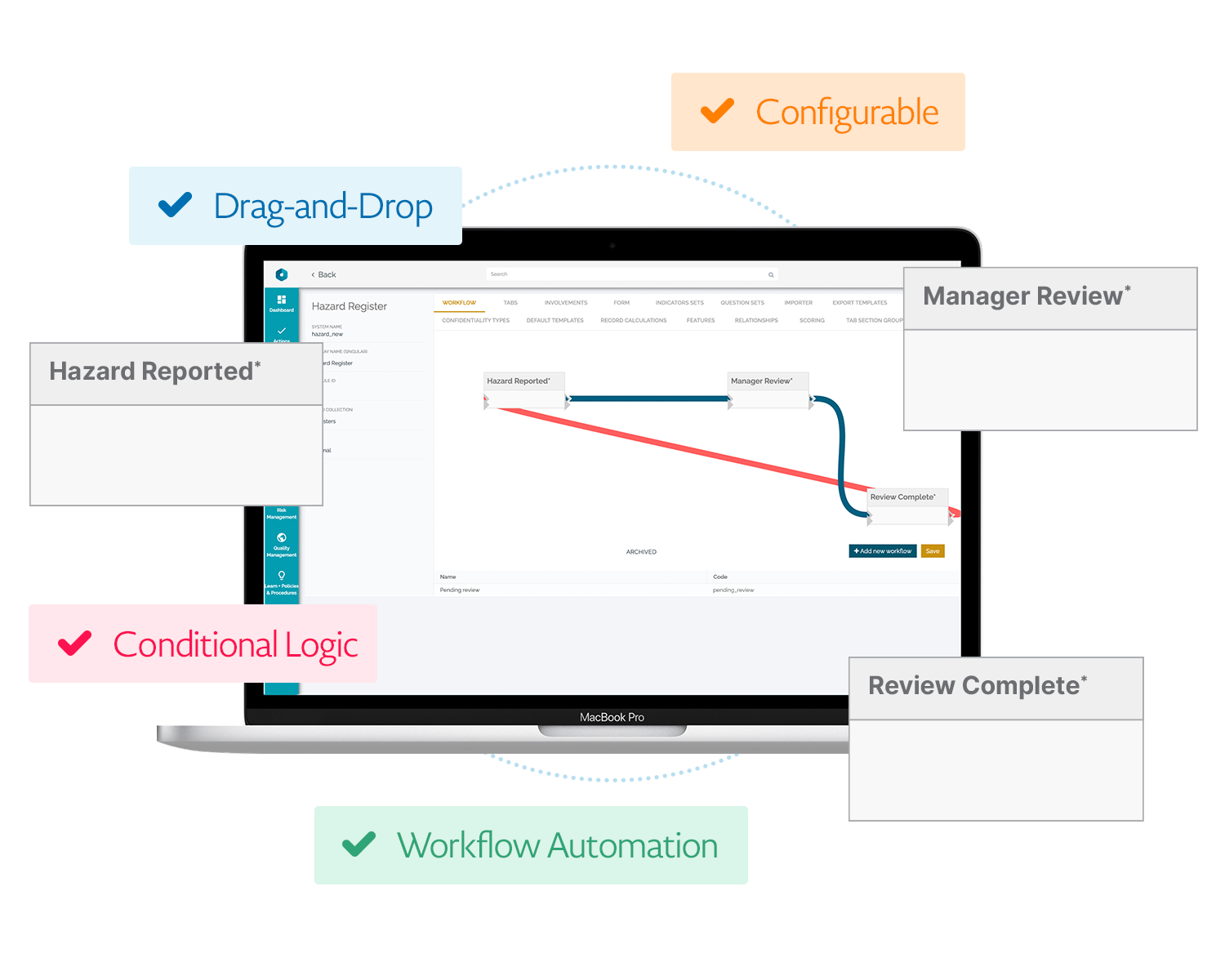
Where WHS Monitor offers a higher disciplined governance framework, Donesafe delivers a true drag-and-drop canvas for safety teams to design, alter, and customise checklists with custom risk calculations, as well as add conditional logic, all without any coding required.
For example, if a frontline worker selects ‘No’ or a question fails, the system can dynamically alter the form layout to force a photo upload or required text box, or it can include a corrective action field. While it improves data collection, it also ensures your organisation is capturing accurate, real-time information.
Donesafe also has dynamic automation rules around scheduling, so safety admins can set up recurring inspection timelines across assets, company positions, and work sites. It sends notifications for upcoming dates, and if an audit is missed, a multi-tier escalation process is triggered to rectify the issue.
And, where a checklist task or audit fails, Donesafe’s intelligent system automatically sets up a CAPA workflow, notifying the owner, tracking due dates, and dynamically executing escalation rules if something hasn’t been addressed.
#### Overall winner: Donesafe
While both platforms offer great CAPA tracking, Donesafe goes a step further, shifting from static checklists to adaptable and dynamic forms that use conditional logic to improve data collection.
3. Risk assessment, ESG, and asset protection
Organisations that manage risk, environmental obligations, and critical assets are better equipped to proactively identify threats and prevent accidents and injuries. That’s why we’ve included it as a core category in our assessment of Donesafe and WHS Monitor.
Here’s what was looked at:
- Risk matrices
- Chemical registry and SDS
- Environmental impact tracking
- Safety workflow integrations with business continuity plans
- JSA and JHA workflows
- Equipment maintenance monitoring
#### WHS Monitor
WHS Monitor delivers some benefits in this category, but the platform has some restrictions. One of the main limitations is in sustainability measure tracking. It’s built purely for operational work health, safety, and core risk compliance, so it offers no out-of-the-box carbon accounting tools, greenhouse gas calculators, or broader ESG dashboard capabilities.
However, it is a market leader in chemical safety management. The platform features a premier proprietary database of more than seven million safety records with a live manufacturer SDS feed. It generates compliant hazard manifests, tracks GHS thresholds, has an automated chemical segregation tool, and can generate chemical QR codes for offline field access.
Beyond these specialised areas, WHS Monitor offers out-of-the-box tools that align with regulatory requirements across key areas, including risk registries, risk management, and asset safety management.
#### Donesafe
With Donesafe’s platform, internal safety admins can enjoy total configuration control, customising risk matrices and using scoring methods to match their organisation’s unique requirements.
And this can all be done without having to work around traditional tracking methods or needing developer support. Admins can be assured that any hazard modifications are pushed in real time across all connected applications.
#### Overall winner: Donesafe
WHS Monitor offers a market-leading chemical safety database and out-of-the-box modules that adhere to standard operational compliance rules, but there’s a key gap in addressing enterprise sustainability needs. Donesafe wins this category because it gives more complex organisations greater flexibility to configure custom risk formulas and track complex environmental metrics.
4. Training, competency, and contractor management
Running a safe operation relies on two key things: training individuals to identify, report, and monitor risks and tracking certifications and licenses for both internal staff and contractors. To ensure success, organisations need safety compliance software that provides robust support for this work.
Here’s what we looked for in this category:
- Dedicated contractor management portals
- Automated training matrices
- Built-in courses
- Inductions and certification management
- Employee profiles
- Policy sign-off tracking
- Access to safety training content
- Site access management
When it comes to contractor portals, WHS Monitor and Donesafe tie, with both platforms delivering automated vendor portals designed to eliminate any compliance gaps. Contractors can self-register and submit all relevant data into the platforms’ portals, where licences, permits, and insurances are monitored.
#### WHS Monitor
In terms of training features, WHS Monitor is capable of storing individual safety certifications and proof of finished courses, but it works more as a training tracker and doesn’t offer built-in e-learning courses for organisations wanting to keep training in one place.
Its visitor management module, however, is extremely secure, supporting self-service registration kiosks and site-specific visitor inductions, and it can integrate with site hardware to print scannable ID labels for emergency tracking.
#### Donesafe
Donesafe matches WHS Monitor’s visitor site access capabilities, offering a visitor management application and touchless kiosk app that visitors can use to scan a QR code and sign in simultaneously. It also ties with WHS Monitor when it comes to centralising skills, training records, and safety licences within a single platform.
#### Overall winner: Donesafe
WHS Monitor and Donesafe both offer well-connected contractor portals and maintain secure training records of employees, but Donesafe has a clear advantage with its fully compliant LMS that features automated rules-based deployment and is.
5. Flexibility, integration, and no-code systems governance
When it comes to workplace health and safety management, each organisation’s needs are unique. Standard processes might suit one corporation, while another business might need a customised approach.
This category determines how easily a system can be adapted or tailored to meet evolving business needs. We assessed app customisation, access governance, live API integrations, document library depth, global setup readiness, and enterprise security for this category.

#### WHS Monitor
For organisations looking to roll out EHS software quickly and have ready-made compliance templates that enforce strict safety standards, WHS Monitor is your go-to.
The platform has two package tiers, Essential Safety (for a maximum of 50 users) and Full Compliance for enterprise. It features live API integrations, so it can easily manage system security settings across pre-defined user roles and data permissions, segmenting dashboards and data as needed for audit-ready isolation across business units.
It meets strict cybersecurity standards, hosting its entire ecosystem on the ISO 27001-certified Microsoft Azure cloud network, and it features database isolation protocols with two-step multifactor authentication (2FA) and Active Directory Single Sign-On (SSO) protection boundaries.
It’s heavily optimised for APAC legislation and regulation, so for international corporations needing localisation support, Donesafe is a safer option. It accommodates frontline teams to record safety inputs in their own language, using full system translations to ensure the data can then be read and reported centrally.
#### Donesafe
While WHS Monitor gives safety teams a quick, templated platform to rely on, Donesafe is the stronger choice for dynamic and complex corporations that want complete architectural control.
The platform is built on no-code architecture, so safety admins can use a visual workflow designer to set up and modify automated risk assessment processes and forms quickly, without the potential risk (and cost) of having to wait for external support. This setup also means admins can build customisable safety dashboards as needed.
For instance, admins wanting to make changes to terminology, replacing ‘incident’ with ‘event’, can simply adjust field labels, picklists, and checkbox logic instantly, without impacting database schemas or rewriting code.
Importantly, Donesafe’s data architecture caters to large corporate clients by letting them run independent, localised libraries across different parts of the business while maintaining a master dashboard oversight. This allows a company to manage separate business units, locations or operational entities independently while maintaining a centralised oversight through enterprise reporting and dashboards.
The platform handles all of this customisation without compromising on data defence. Donesafe is fully ISO 27001 certified and GDPR compliant, running on Amazon Web Services (AWS) infrastructure that features bank-grade SSL 256-bit encryption in transit and at rest, AWS data loss prevention systems, automated continuous cloud backups, and strict data sovereignty rules.
#### Overall winner: Donesafe
You’ll get enterprise-grade cloud security and API-connected enterprise environments with both platforms, but where Donesafe excels is in its configuration freedom, giving WHS teams the flexibility to build and modify as needed.
6. Visual dashboards, BI analytics, and real value
Our last category dives into the value each software platform brings to an organisation. We looked at features like dashboard functionality, report-building opportunities, client support infrastructure, ROI transparency, scalability, and multi-entity governance.
#### WHS Monitor
If you’re looking to roll out live compliance workspaces almost immediately with minimal paid setup, then WHS Monitor might be the right fit for your business.
It has a built-in library of more than 100 highly structured safety queries and 3,500 industry-standard forms and pre-packaged templates already aligned to Australian WHS legislation and ISO standards.
#### Donesafe
If you’re after more flexibility and customisation with your EHS software, then Donesafe is more likely the better fit.
Different team members, from frontline workers to corporate executives, can see real-time safety indicators tailored to their needs, thanks to the platform’s consumer-grade drag-and-drop dashboard widgets. Safety admins can cross-filter across separate applications and variables, meaning they can compile, save, and automate reports from different modules independently.
The platform also handles multi-entity subsidiary isolation perfectly, feeding separate business data back into a centralised dashboard that can scale dynamically with business growth.
#### Overall winner: It’s a tie
Both platforms scored a 4/4 for this category, with very different justifications.
Overall, while WHS Monitor’s text-heavy interface can be a little cumbersome to work with, there are virtually no implementation delays, making it a great option for highly transparent, ready-to-go standard reporting needs.
With Donesafe, the real value comes a little further down the track. Its open-ended layout does need upfront configuration mapping during implementation, but once it’s up and running, it offers long-term analytical autonomy for more complex corporations.
The final verdict: Why Donesafe is the platform of choice
If you’re looking for a robust, prescriptive EHS software that works out of the box, WHS Monitor is a great option. However, larger organisations require a little more complexity when it comes to their EHS software, and that’s where Donesafe excels. It delivers a structural agility that flexes to your business’s needs, across sites, jurisdictions, and business units.
Donesafe provides the platform for safety teams to have full, code-free administrative independence, without any external input or developer costs. Admins can modify existing modules or build applications, workflows, and reports they want from scratch and tailor them to already established internal systems and processes.
If you’d like to learn more about how Donesafe can adapt to your organisational needs, get in touch today for a personalised architecture demonstration.
FAQs
What is WHS software?
Workplace Health and Safety software helps organisations manage workplace health and safety processes all in one place, from workplace incidents and reports to inspections, assessments, and training. EHS software, like Donesafe, expands on this to include environmental management.
What’s the difference between Donesafe and WHS Monitor?
Both Donesafe and WHS Monitor are EHS platforms, but they differ in terms of their user approach. WHS Monitor offers out-of-the-box, compliant audit and inspection templates that require external support for any customisation. Donesafe lets safety admins independently build and configure its no-code system to match business needs.
What companies use Donesafe?
Donesafe is a configurable EHS platform used by large corporations, such as McDonald’s, Coca-Cola, and Deloitte, for its no-code, scalable, enterprise-grade modules that are connected through a single platform, removing the need for multiple-point solutions.
Is Donesafe or WHS Monitor better for regulatory compliance?
Both platforms support WHS compliance. While WHS Monitor uses predefined processes and templates, Donesafe lets organisations adapt compliance workflows to reflect their own structures and jurisdictions.
Share: