US
 NZ
 UK
 SG
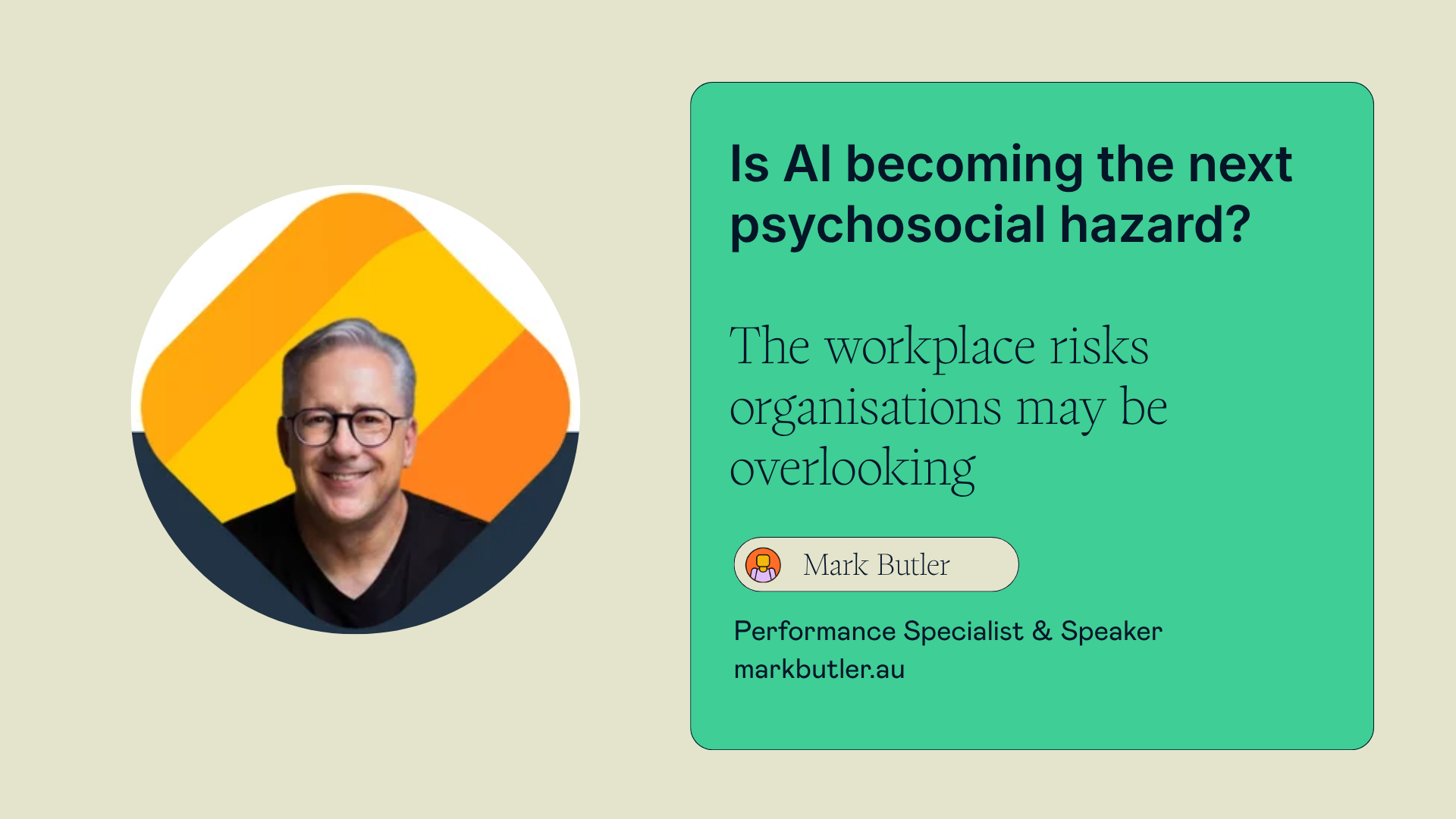
At the 2026 WHS Show in Sydney last month, performance specialist and mental health expert Mark Butler posed a question that is becoming increasingly relevant for organisations adopting artificial intelligence: Is AI becoming the next psychosocial hazard?
With 25 years of corporate experience and 15 years of clinical experience as an accredited clinical psychotherapist and program director, Mark specialises in sustainable peak performance for high-pressure teams and leaders. He works with organisations and governments to proactively prevent mental health issues and burnout, shifting workplace approaches from reactive intervention towards prevention. See his website here.
He is also one of ten committee members of the World Federation for Mental Health’s Workplace Section, which advises the UN, WHO and governments on workplace mental health treatment and prevention.
Marks presentation explored an emerging challenge for workplace health and safety professionals: while AI is changing how organisations operate and how work gets done, the implications for the people doing that work may not be receiving the same attention.
His answer was more nuanced than a simple yes or no. AI, he argued, is not itself a psychosocial hazard. Rather, it is changing the conditions under which people work, creating new pressures and potentially amplifying existing psychosocial risks.
It is a distinction with significant implications for how organisations approach technology adoption, work design and employee wellbeing.
AI is changing the system of work
One of the central arguments in Mark’s presentation was that AI needs to be understood as a system-level change, rather than simply another workplace exposure.
“AI is redesigning the work that we do,”
he explained, arguing that this makes it something organisations need to consider within their risk management processes.
The reasoning is straightforward. When organisations change how work is designed, allocated, monitored and evaluated, they also change the conditions in which people perform that work.
Some existing hazards may become more pronounced, while entirely new pressures can emerge.
To illustrate this, Mark drew a comparison with burnout. While burnout is not itself a psychosocial hazard, it can be an outcome of exposure to multiple interacting workplace hazards. He explained that burnout is associated with every recognised psychosocial hazard, with those hazards also having the potential to amplify one another.
He identified three key dimensions through which burnout commonly manifests:
- Exhaustion: Physical, mental and emotional depletion, with emotional exhaustion requiring particular attention.
- Cynicism: Increasing detachment from work, colleagues and the organisation.
- Reduced efficacy: A diminished sense of being capable of performing work to the standard a person previously achieved.
These three dimensions provided a framework for examining how AI-related workplace pressures might affect employees.
Mark’s argument was that AI changes the system, the system influences psychosocial hazards, and those hazards can ultimately affect the people working within it.
1. The efficiency paradox: when removing tasks increases cognitive load
One of the more surprising observations in Mark’s presentation concerned the relationship between AI-driven efficiency and employee exhaustion.
AI is frequently introduced to remove repetitive, administrative and relatively straightforward tasks. The expectation is that employees will spend less time on routine work and have more capacity for complex, higher-value activities.
However, Mark highlighted an important consideration: those smaller tasks also provide opportunities for mental recovery and a sense of accomplishment throughout the working day.
Completing a document, organising a calendar, clearing an administrative task or working through a to-do list provides a visible sense of progress. These activities can offer moments of completion between more demanding cognitive responsibilities.
When AI takes over a greater proportion of this work, employees may find themselves with fewer opportunities to experience those smaller achievements, while the more demanding aspects of their roles remain.
“In removing those tasks, what it’s actually done is taken away the sort of recovery in our day,” Mark explained.
The result can be a working day increasingly dominated by complex thinking, decision-making and problem-solving, without the natural variation that previously existed.
Mark referenced research indicating that 83% of workers surveyed reported an increase in workload associated with AI.
His interpretation was particularly interesting. The issue may not necessarily be an increase in the volume of work, but an increase in its cognitive demands.
“It hasn’t increased the volume of work. It’s increased the weight of the work.”
This raises an important question for organisations measuring the success of AI adoption. Reducing the time required to complete individual tasks does not necessarily mean employees have less work to manage or that their overall workload has become more sustainable.
The nature of the work matters just as much as the amount of it.
2. Work slop and the erosion of team trust
A second emerging pressure Mark explored was what he described as work slop.
While AI-generated content is often discussed in terms of its appearance, work slop refers to something more specific: work that has been produced or completed using AI, looks polished and presentable, but lacks the substance, accuracy or completeness required by the person receiving it.
The difficulty is that the time saved by the person producing the work can become additional work for someone else.
A colleague receiving an AI-generated document may need to spend considerable time identifying missing information, correcting errors, checking assumptions and establishing what the original author intended.
Mark described the experience as receiving work that looks finished but requires significant additional effort before it can be used.
He referenced research indicating that 40% of workers receive work slop at least monthly.
The implications extend beyond productivity.
When someone repeatedly receives work that requires substantial reworking, frustration can develop. However, raising the issue is not always straightforward, particularly when AI adoption is actively encouraged within the organisation.
Questioning the quality of a colleague’s AI-assisted work can become an uncomfortable conversation, especially when the technology is positioned as a productivity improvement.
Mark argued that the resulting damage can extend into fairness, trust and team cohesion.
“The real damage isn’t in having to do the rework. The real damage is actually what the recipient thinks of what the sender is doing and saying to them.”
This is an important distinction.
The concern is not simply that AI can produce inadequate work. It is that the way AI is being used can change the expectations people have of one another, redistribute work unevenly and introduce friction into professional relationships.
This creates a reason to consider how AI-assisted work is reviewed, shared and managed across teams, rather than evaluating its success solely by the time saved by the original user.
3. The accountability gap: responsibility without control
The third pressure Mark discussed was reduced efficacy, which he considered particularly important to watch as AI becomes more embedded in workplace processes.
He explored a scenario involving two employees assigned the same task by a manager. Both use AI to assist with their work, but each receives slightly different outputs.
The manager is then presented with two different versions of the work, both influenced by AI, with potentially different assumptions, recommendations or conclusions.
Then… who owns the final outcome?
Mark explained that AI does not necessarily produce consistent answers, even when users are working towards the same objective. This can make accountability difficult to establish, particularly when responsibilities and decision-making authority have not been clearly defined.
He introduced the concept of the moral crumple zone, describing a situation where responsibility for an outcome ultimately falls to the person closest to the problem, regardless of how much control they had over the processes that contributed to it.
This creates a potentially significant psychosocial risk.
An individual may carry substantial responsibility for an outcome without having had meaningful control over how that outcome was generated.
Mark described this combination of high responsibility and low control as a particularly concerning pathway towards burnout.
It also exposes a limitation in how organisations traditionally think about accountability.
When AI contributes to work, the person who ultimately delivers or signs off on an outcome may not be the person who created all the inputs, assumptions or recommendations behind it.
If ownership is unclear, employees can find themselves accountable for decisions they cannot fully explain or control.
For safety and organisational leaders, this raises practical questions about decision-making authority, oversight, role clarity and the boundaries of human responsibility when AI is involved.
4. The investment imbalance: technology, processes and people
While much of Mark’s presentation focused on emerging risks, he also highlighted an opportunity for organisations to reconsider how they approach AI implementation.
Referencing McKinsey research published in August 2026, How to close the agentic adoption gap, he presented a proposed investment ratio of 1:3:5.
For every dollar invested in agentic AI technology, the research describes successful transformations as allocating:
- $3 to process redesign: Understanding how work needs to change to accommodate the technology.
- $5 to capability building and adoption: Developing the skills, knowledge and organisational support needed for successful implementation.
McKinsey’s article argues that organisations frequently invert this pattern, prioritising technology while treating capability building and behavioural change as secondary implementation activities.
This reinforces a central theme of Mark’s presentation: technology investment alone is insufficient.
Introducing AI into an existing process without reconsidering how that process works can create new inefficiencies, additional pressures and confusion around responsibilities.
Equally, employees need the skills and support to understand how to use AI appropriately, where human judgement remains necessary and what is expected of them when technology contributes to their work.
The investment ratio provides a useful challenge for organisations evaluating their AI strategies. Successful adoption requires more than making technology available. It requires understanding how the work itself will change and ensuring employees are equipped to work within that new environment.
Why the conversations matter more than ever
Perhaps the most important message from Mark’s presentation was the role of leadership in identifying and responding to these emerging pressures.
Traditional risk management approaches often begin with identifying a hazard and working forward towards an appropriate control.
However, when AI changes the design of work in less visible ways, the consequences may not become apparent until employees begin experiencing them.
This means leaders need to pay attention to what is happening within their teams, including changes in workload, working relationships, confidence and employees’ ability to perform their roles effectively.
Mark acknowledged that these conversations are not always easy. He referenced research indicating that 60% of leaders would avoid difficult conversations if they could.
Yet, without those conversations, organisations risk missing the early indicators that something in the way work is designed is not functioning as intended.
Mark’s broader philosophy places particular importance on four foundations of effective teamwork: Safety, Trust, Belonging and Mattering.
These principles are especially relevant when considering the introduction of technologies that can change people’s responsibilities, professional identities and relationships with colleagues.
Employees need to feel safe raising concerns, trust that their contributions remain valued, belong within the teams they work in and understand that their work continues to matter.
He offered a particularly memorable observation:
“Every successful idea, every successful business started with an idea and then began a conversation. In actual fact, every failed process or every failed venture happens because of a conversation that couldn’t be had.”
For Mark, meaningful conversations between leaders and employees are essential to understanding how changes to work are affecting people.
He suggested two questions that leaders should take back to their organisations:
What are you seeing in your people that you’re not having a conversation about?
And what conversation are you not having?
They are simple questions, but they invite a different level of consideration when assessing the impact of workplace change.
Looking ahead
Mark’s presentation offered an important perspective on an area that workplace health and safety professionals will increasingly need to consider.
AI is changing how organisations distribute work, evaluate performance, make decisions and allocate responsibility. Those changes have the potential to influence multiple psychosocial hazards, often in ways that may not be immediately obvious.
The emerging challenge is understanding those effects early enough to respond.
That means looking beyond the immediate productivity gains of new technology and considering the broader working environment it creates: whether workloads remain sustainable, whether teams maintain trust, whether employees retain the confidence and control needed to perform their roles, and whether accountability remains clear.
As Mark’s research continues to develop, so too will our understanding of the relationship between AI, work design and psychosocial risk.
For organisations introducing AI into their operations, his message provides a valuable starting point: understand how the work is changing, pay attention to how those changes affect people, and make sure the conversations are happening before the consequences become harder to manage.
About Mark Butler
Mark Butler is a mental health expert, performance specialist and speaker specialising in sustainable peak performance for high-pressure teams and leaders. With 25 years of corporate experience and 15 years of clinical experience as an accredited Clinical Psychotherapist and Program Director, Mark works with organisations and governments around the world to proactively prevent mental health issues and burnout.
He is a committee member of the World Federation for Mental Health’s Workplace Section, one of ten members advising the UN, WHO and governments on workplace mental health treatment and prevention.
Download Marks Resources and Whitepapers
Further reading: McKinsey: How to close the agentic adoption gap
Share: