AU
AU US
US NZ
NZ SG
SG
Compliance Activities Can Be Completed While the Exposure Remains
Compliance management gives an organisation structure. It helps teams identify obligations, assign responsibilities, set deadlines and retain evidence. The weakness appears when completion becomes the final test.
Consider a contractor whose induction and online training are current. The learning record shows green, but the contractor’s waste carrier licence has expired and site authorisation sits in another system. The supervisor sees a completed course, not the full readiness picture.
The same gap appears with control measures. A risk assessment can specify guarding, isolation or an exclusion zone, but the document alone cannot show whether those controls have been followed and working during the job.
ISO 45001 addresses that wider management system by linking competence, operational controls, performance monitoring and continual improvement. Together, those elements give leaders stronger evidence when work begins, conditions change or performance starts to slip.
Hidden Risk Lives in the Handoffs
Most organisations have a series of safety processes and procedures, but they struggle when one process must inform the next.
An inspection identifies damaged machine guarding. The finding enters the action tracker, while the repair request moves into email. The inspection is completed , but the machine remains available and no one verifies the repair.
That example shows how exposure can remain when information loses its context as it moves between people and systems. The most important handoffs include:
- Readiness to authorisation: Training, competence and certification must reach the person approving the work.
- Finding to ownership: Audit, inspection and incident findings need a named owner, priority and due date.
- Closure to verification: A completed task needs evidence that the control was implemented and addressed the exposure.
When actions move into local spreadsheets or inboxes, context and accountability become easier to lose. Fragmentation can also hide patterns. Two sites may investigate similar dropped-object near misses and close local actions. Without connected categories, causes and controls, leadership sees two completed cases rather than one recurring weakness or an opportunity to introduce a preventative measure, not just corrective action in isolation.
What Operational Assurance Looks Like Across the Lifecycle
Closing those gaps requires a clear line of sight across the whole OHS system. Leaders need to see how legal obligations shape the work, whether people and controls are ready, what happens when performance falls short, and whether the response produces lasting improvement.
Operational assurance brings that evidence together. In practice, it should help leaders answer four questions:
- Are we meeting our legal obligations and company requirements?
- Are employees, contractors and others ready for the work?
- Are the required controls functioning?
- Are problems being resolved and lessons sustained?
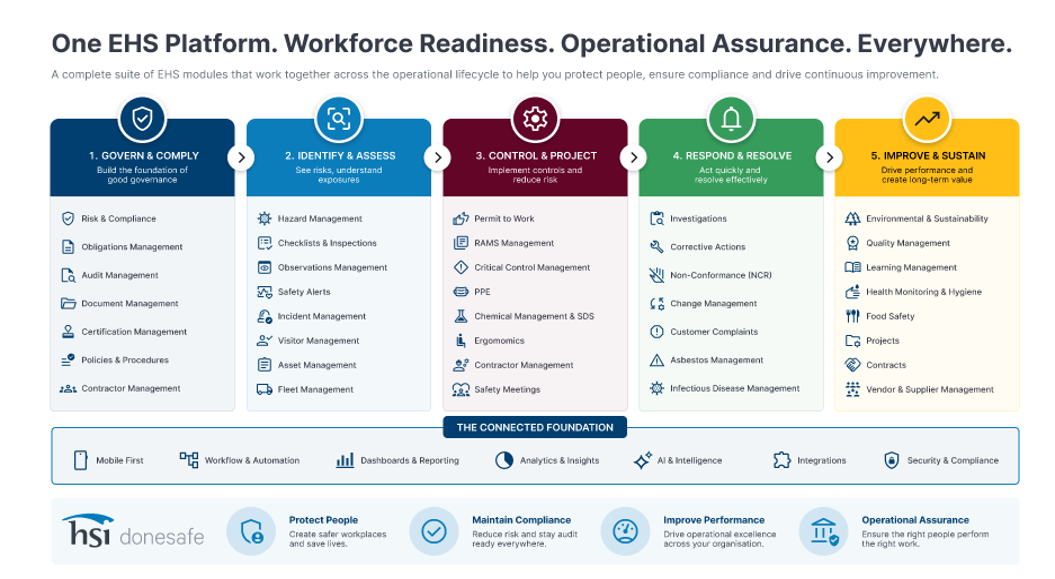
The five stages of the operational lifecycle show how the organisation builds and maintains that confidence.
Govern & Comply
Define obligations, standards, responsibilities and approvals. This establishes what the organisation expects and who owns each requirement.
Identify & Assess
Capture hazards, identify persons at risk, assess risk and recognise significant changes . The results should guide work planning and control decisions.
Control & Protect
Apply controls and confirm that the workforce is ready to use them. Higher-risk work may require additional checks tied to the person, task, equipment/materials and conditions.
Respond & Resolve
Investigate events, assign action(s) and escalate high-risk items that stall. Close-out should show that the action reached the field, and addressed the issue
Improve & Sustain
Review trends across the organisation, carry lessons into safe systems and training, and check whether improvements remain effective.
These stages only provide assurance when they share a connected foundation. Frontline access supports reporting and verification. Automation and integrations carry information to the right owner. Dashboards and analytics help leaders see the patterns behind the numbers.
ISO 45001 uses the Plan-Do-Check-Act approach to manage occupational health and safety systems effectively. A connected operational lifecycle applies the same discipline to the way information moves, decisions are made and actions are followed through to completion before informing on the next improvement to implement.
Better Decisions Depend on Better Exceptions
A connected system creates value when the right person can recognise an exception and act.
A supervisor needs to know whether a contractor is authorised before proceeding work. An OHS leader needs to see when the same control fails at several sites. An executive needs to know whether high-risk actions are ageing, critical controls are failing or workforce gaps are affecting operations.
| Decision | Evidence needed |
| Authorise a worker or contractor | Current competence, certification, induction and task or site risk assessments / method statements (RAMS) |
| Accept that a control is effective | Field checks, inspection results and relevant incident or observation data (supervision) |
| Close a corrective action | Completion evidence, approval and an effectiveness check where warranted |
| Escalate an issue | Risk level, control status, recurrence and wider exposure, and failed owner |
This is why workforce readiness and competency management must connect with the wider EHS picture. A training-completion percentage alone cannot tell a supervisor whether the right person is ready for the right work under current conditions. The same limitation applies at the executive level, where aggregate injury rates and audit scores can still conceal a failed critical control or a growing backlog of high-risk actions.
Connecting the Lifecycle with HSI Donesafe
Organisations moving toward operational assurance need a system that preserves the relationship between people, risks, controls, findings and action.
HSI Donesafe provides a configurable EHSQ platform that connects workflows across the operational lifecycle. Its product structure supports the three outcomes shown in this go to market (GTM) model:
- Protect people: Connect workforce readiness with hazard, control and work-authorisation information.
- Maintain compliance: Link audits, incidents and corrective actions through to closure, with ownership, priorities and audit trails kept together.
- Improve performance: Use connected reporting to identify recurring themes, monitor control performance and direct attention to unresolved exposure.
Explore how HSI Donesafe can connect OHS processes across the operational lifecycle, starting with the workflows where missed handoffs create the greatest risk.
Frequently Asked Questions (FAQs)
Is operational assurance a legal or ISO 45001 requirement?
Operational assurance is a broad management concept rather than one legal requirement or a single ISO 45001 clause. It brings together established expectations around competence, risk control, monitoring, corrective action and management review. Organisations still need to meet the legal duties that apply to their work.
How should an organisation measure operational assurance?
Use indicators that show exceptions and follow-through, not activity volume alone. Examples include workforce-readiness gaps, failed critical-control checks, overdue high-risk actions, repeat findings and time to verified close-out. The measures should help leaders decide where intervention is needed.
How is workforce readiness different from training compliance?
Training compliance confirms that assigned learning was completed. Workforce readiness also considers competence, current company licences and individual certifications, site induction, supervision requirements and authorisation for the specific task. The evidence should match the work, location and level of risk.
Can an organisation build operational assurance without replacing every system?
Yes. Start with one high-risk workflow and define the information, ownership, escalation and verification needed at each handoff. Then assess whether existing systems can support that flow or whether a connected platform is needed before expanding into adjacent processes.
What is the difference between compliance management and operational assurance?
Compliance management focuses on demonstrating that required activities have been completed, such as training, inspections or audits. Operational assurance builds on that foundation by connecting people, risks, controls and corrective actions to show whether those activities are reducing risk and improving operational performance in practice.
Share: