AU
AU NZ
NZ UK
UK SG
SG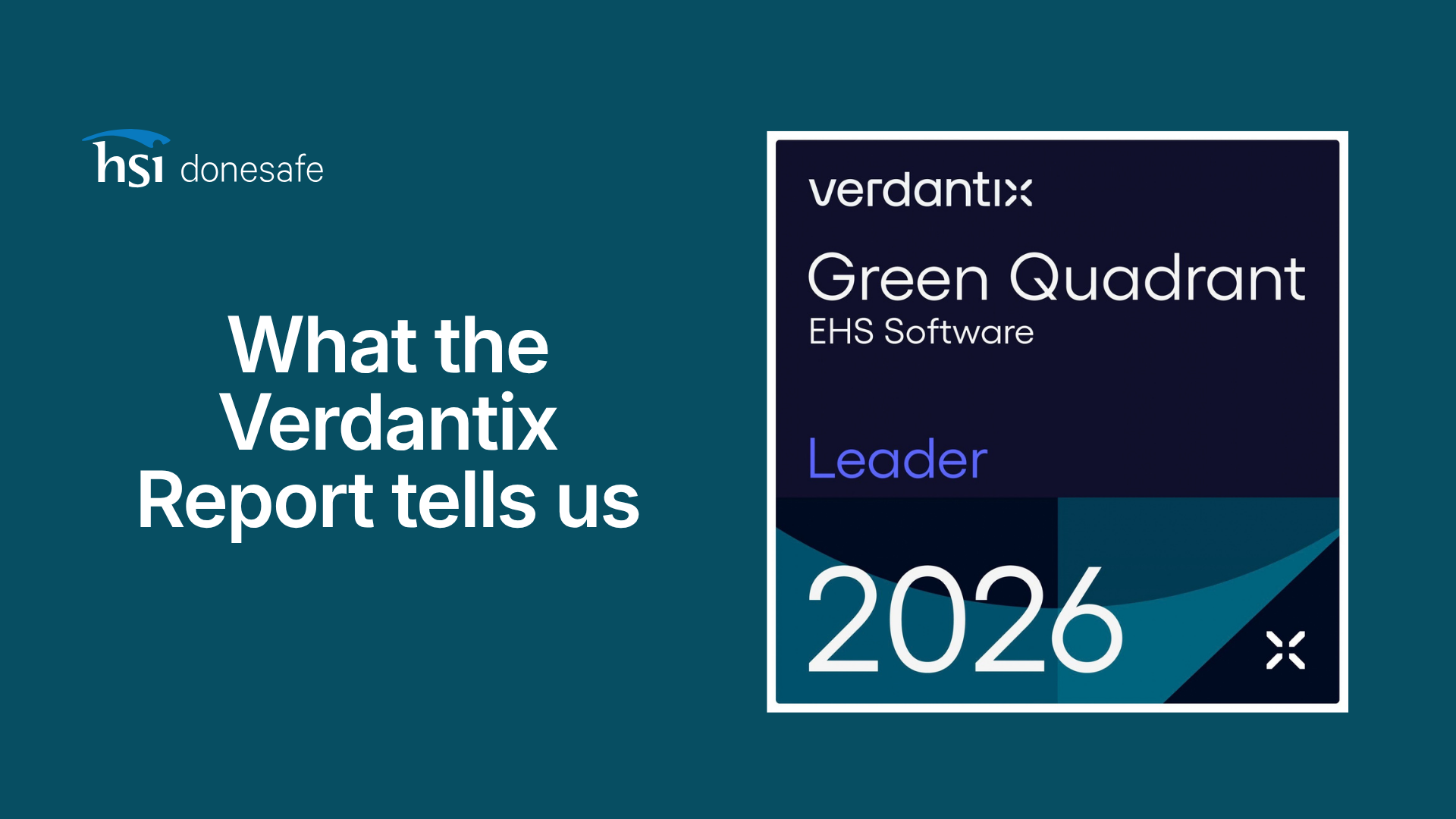
AI has quickly become part of almost every EHS software conversation. Vendors are talking about copilots, intelligent workflows, predictive insights and automated recommendations. For EHS leaders, that makes it worth looking beyond the presence of AI and asking what the technology is helping people do with the information they already have.
The 2026 Verdantix Green Quadrant for EHS Software provides a useful view of where the market is heading. Verdantix assessed 24 prominent EHS software vendors using a 269-point questionnaire, live product demonstrations and 42 customer interviews.
HSI was named a Leader in the report, with particular recognition for its training capabilities, AI and chemical management.
There are several findings worth examining more closely because they reflect a broader change in how EHS technology is being used. The strongest platforms are moving beyond the role of systems of record. They are becoming places where organisations can bring together information, understand what it is telling them and act on it.
Training is becoming part of the wider risk conversation
Training has traditionally been treated as a compliance requirement. Someone needs to complete a course, a record needs to be kept and the organisation needs to demonstrate that required training has been completed.
That view misses some of the information sitting behind those records.
Training data can tell an organisation where capability gaps exist, how requirements differ between roles and where a person’s learning needs may change as their work changes. When that information is connected to the wider EHS environment, training becomes more closely tied to how risk is managed.
This is one of the clearest areas where the Verdantix report identifies a strength for HSI.
HSI achieved the highest training score across all vendors assessed: 2.8/3.0
Verdantix recognised HSI’s training capabilities as its strongest area, supported by an in-house library of more than 5,000 courses.
The more interesting development is how AI can be applied to that capability. HSI can use information such as an employee’s history, role and operational data to identify training gaps, recommend relevant learning content and generate tailored learning paths.
That changes the way an organisation can think about training.
Rather than starting with a catalogue and asking which courses people should complete, EHS teams can start with the workforce and the work. Where are capability gaps emerging? Are people receiving training that reflects the risks associated with their role? Has something changed that should trigger a different learning requirement?
Those questions connect competence more closely with risk management.
For an EHS leader, that has practical implications. Training is one of the mechanisms an organisation has for making sure people understand the risks associated with their work and know what is expected of them. Technology can make that process more responsive when the information used to determine training needs is kept current and connected to the rest of the organisation.
AI needs a job to do
The EHS software market is moving quickly towards AI. As more vendors introduce AI capabilities, the label itself tells buyers less about what a platform can deliver.
A better assessment starts with the task.
Where is AI identifying something a person may otherwise miss? Where can it reduce manual work? Can it help an EHS professional make sense of a large volume of information or determine what needs attention first?
The Verdantix findings provide a useful example through HSI’s training capabilities. AI can identify training gaps and recommend relevant learning based on employee, role and operational data. Verdantix also highlights HSI’s RAG-based LLM, Sky, as well as support for external AI integration through Model Context Protocol.
The value lies in how those capabilities interact with the information held within an EHS environment.
That is particularly relevant as organisations start considering where AI should sit within safety and compliance processes. There is a difference between an AI feature that produces a response and one that can work with trusted organisational information to help someone perform a task.
It also raises the issue of trust.
When AI is used in processes connected to safety, compliance or workforce decisions, organisations need to understand what information it is working from, how outputs are generated and where human judgement remains part of the process. An EHS professional should be able to assess an AI-generated recommendation rather than simply accept it.
For buyers, this makes the AI conversation more useful when it moves away from feature lists and towards specific outcomes.
EHS data is more useful when it works together
The shift towards connected information extends beyond AI.
EHS teams work across safety, training, risk, chemicals, compliance and operational activities, yet those areas have often been managed through separate systems. A training record may sit in one place, a risk assessment in another and chemical information somewhere else.
The information exists, but the connections between it can be difficult to see.
That has consequences for the people responsible for managing risk. Time is spent finding, reconciling and interpreting information before a decision can be made. More importantly, relationships between different areas of EHS can be missed.
This is where platform architecture becomes relevant.
Verdantix highlights HSI’s microservices-based architecture and GraphQL framework, which have supported the integration of acquired technologies into a unified platform.
For organisations looking to consolidate safety reporting and workforce training, the value of bringing functionality together isn’t simply having more features under one login. It is the ability to use information from different areas of EHS management in the same context.
A training gap can be considered alongside an employee’s role and operational environment. Safety information can be considered alongside risk information. Chemical information can sit within the same broader EHS environment.
That creates more scope for organisations to see patterns and relationships that are difficult to identify when information remains separated across multiple systems.
For EHS leaders, this is an important consideration when assessing a platform. The question isn’t only what functions it contains. It is also what those functions can tell you when the underlying information is connected.
The technology should support the people doing the work
The quality of an EHS platform also depends on the experience of the people using it.
Verdantix describes HSI as providing an intuitive web and mobile experience, including workflow status indicators and visibility into workflow participants and activities.
That becomes particularly relevant in EHS because the person completing a task is often far removed from the EHS office. They may be working on a production floor, construction site, warehouse, vehicle or other field environment, with limited time and attention available for administrative processes.
A platform can contain sophisticated functionality and still fall short if users struggle to find information, understand what they need to do or complete a workflow.
Adoption therefore deserves a place alongside functionality when organisations assess EHS technology. The system needs to make sense to the people responsible for entering information, completing actions and responding to risks, as well as to the people analysing that information at a management level.
That balance between capability and usability will become more important as EHS platforms take on more responsibility for connecting information and supporting decisions.
What should EHS leaders be asking their technology providers?
The Verdantix report provides a useful benchmark for understanding the capabilities available in the market. It can also be used as a starting point for better conversations with technology providers.
1. Where is AI improving the way we work?
Look beyond the feature list. Ask where AI is identifying gaps, reducing manual work, helping people interpret information or supporting better decisions.
A useful AI capability should have a clear job to do.
2. What information can the technology connect?
Consider the information your teams need to understand risk, capability and compliance.
Can the platform connect that information in a meaningful way, or will your teams continue to move between separate systems to build the picture themselves?
3. Can training respond to the reality of the workforce?
Training requirements change as people move roles, work changes and operational risks evolve.
Ask how the platform identifies those changes and whether training recommendations can reflect the workforce and its operating environment.
4. How is AI being used responsibly?
As AI becomes more involved in EHS processes, organisations need clarity around the information it uses, the outputs it produces and where people remain accountable for decisions.
This should form part of the technology assessment rather than being considered after implementation.
5. Can the platform grow with the organisation?
EHS requirements rarely stay static. Organisations change, workforces change and the risks they manage change with them.
The technology needs to accommodate changing organisational structures, workflows, regulatory requirements, workforce needs and technology without creating another collection of disconnected systems.
What the Verdantix findings tell us about EHS technology
Being named a Leader in the 2026 Verdantix Green Quadrant is important recognition for HSI. The individual findings, however, offer a more useful perspective on where EHS technology is heading.
Leader
HSI was named a Leader in the 2026 Green Quadrant for EHS Software.
Highest training score
HSI achieved 2.8/3.0, the highest training score across all vendors assessed.
5,000+ courses
HSI’s in-house training library provides extensive safety and compliance learning content.
3.5m+ SDSs
HSI’s proprietary safety data sheet library supports its chemicals management capabilities.
7,000+ organisations
HSI’s customer base now exceeds 7,000 organisations.
The numbers demonstrate scale and capability, but they also point to something broader happening in the EHS technology market.
For years, EHS software has largely been used to capture information, maintain records and demonstrate compliance. Those functions remain necessary, but organisations are asking more of their technology as the volume and complexity of EHS information grows.
They need to understand what the information is telling them, identify where attention is required and make it easier for people to act on that information. They also need technology that can bring together the different parts of EHS management rather than adding another layer of disconnected data.
AI will have a role in that shift, particularly where it can work with trusted organisational information and help people identify patterns, gaps and actions.
The larger opportunity sits with the platform around it.
Connected information, useful intelligence and a workforce with the right knowledge give EHS leaders a stronger basis for understanding risk and making decisions. That is a more useful way to think about the next generation of EHS technology than simply asking which vendors have AI.
The question for EHS leaders is becoming less about how much functionality a platform contains and more about what the organisation can understand and do with the information it holds.
Share: