AU
AU NZ
NZ UK
UK SG
SG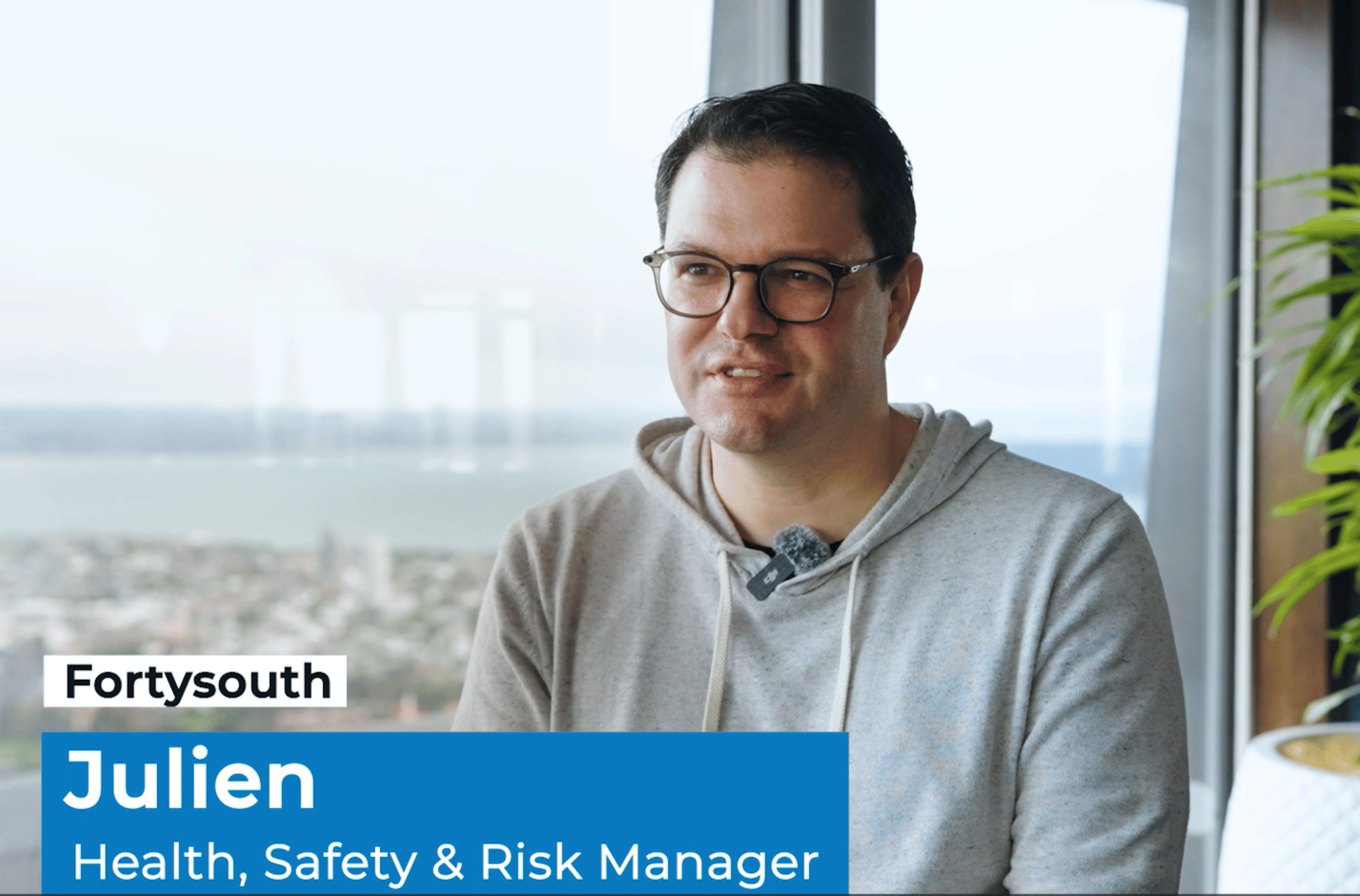
Watch our discussion with Julien
Hear directly from Julien Cano, Health Safety and Risk Manager, about how Forty South introduced Donesafe across more than 2,000 sites, expanded its use beyond traditional safety processes and continues to evolve the platform around the organisation’s needs.
How Forty South used flexible EHS software to launch across 2,000 sites and keep expanding
When Forty South was established, Julien and his team had an immediate challenge: build practical, consistent processes across more than 2,000 sites while the organisation itself was still taking shape.
That meant they needed technology that could move quickly. But speed was only the beginning.
As people across the organisation started using Donesafe, they found new ways to apply it beyond traditional health and safety processes. Site surveys, asset inspections, drone operations, preventative maintenance and contractor workflows were brought into the same platform.
For Julien, that evolution has been one of the biggest advantages of choosing a flexible EHS platform.
“One of the key things as a new organisation is that you move quickly and the ability to tailor it to your needs. The flexibility of the tool is essential for us to win.”
His experience raises an important question for organisations investing in safety technology:
Are you choosing a system that solves today’s requirements, or one that can keep pace with the organisation you are building?
Speed to value starts with the right foundation
Launching a new organisation across thousands of sites creates very little room for a long technology implementation.
Forty South needed to establish processes quickly, while still having enough flexibility to adapt them as the business developed.
Starting with pre-built Donesafe modules gave the team an established foundation across core safety processes, without requiring every workflow to be designed from the ground up.
“Donesafe has pre-built modules and so that was the right thing for us. Although we were new, we started with already 2,000 sites. So, it was important for us to be able to start quickly.”
That combination of ready-made functionality and configurability became important as the organisation matured.
Julien’s experience highlights a consideration often overlooked during technology selection: how much work will the system require before it can start delivering value?
A platform that can provide a strong starting point, then be adapted to reflect the way an organisation actually operates, gives teams more room to focus on improving their processes rather than continually building technology around them.
Breaking safety out of its traditional silo
Forty South initially approached Donesafe as a safety solution.
That meant familiar applications such as incident management, risk registers and audits.
But once people started interacting with the platform, they began to see possibilities beyond the traditional boundaries of EHS.
“We started with Donesafe as a safety solution and we brought it to do incident management, risk registers, audits. But over time as people started to interact with it they found actually that it was really practical and really easy to use in the field and so people started to want to use it for operations.”
That shift is significant.
Technology adoption is often discussed as a change-management problem: how do you get people to use the system?
Forty South’s experience suggests another way to look at it.
Make the technology genuinely useful to people and its role can expand organically.
At Forty South, Donesafe is now being used for operational processes including drone operations, digital twins and asset inspections. The platform has become useful because it reflects the work people are actually doing, rather than requiring every interaction to sit neatly inside a traditional safety category.
Put accountability where the work happens
For organisations managing large numbers of sites, assets and external delivery partners, visibility becomes harder as operations become more distributed. Forty South uses Donesafe to support planned and preventative maintenance, bringing contractors and delivery partners into the process.
The workflow gives contractors a clear process for assessing the site, documenting the condition before work, completing the job and capturing evidence afterwards. That creates a consistent record of what happened at the site while making it easier for Forty South to understand the condition of its assets.
“They start by doing an assessment of the site and identifying what type of jobs they will have to undertake and take a few photos of before, complete the work, declare when it’s been done and take photos after.”
The value here goes beyond contractor administration. For an organisation responsible for a large asset portfolio, every completed job can contribute another piece of information about the condition of those assets.
That creates greater visibility for the people responsible for managing them and helps ensure sites are left in the condition expected by the organisation and its communities.
As Julien explains:
“That’s basically what helps us to make sure that the sites are left in good conditions for our community.”
Every site visit is an opportunity to learn more
Risk management depends on having good information about the environment where work is taking place.
For Forty South, that means continually improving its understanding of its assets and sharing that information with the people who need it. One way the organisation does this is through Donesafe public forms, which allow people who are not regular Donesafe users to contribute information. Its site survey process is used to capture new information about assets as people interact with them.
“Every time there’s someone going to a site, it’s an opportunity for us to collect data.”
That creates a useful feedback loop.
People visit sites. They capture information. The organisation’s understanding of those assets improves. That information can then help the next person plan their visit and approach the work with better context.
“Every day we get new information, new insights to improve the information about our assets and provide better information to people working on assets.”
For EHS and operational leaders, there is an important principle here.
The quality of a risk decision can only be as good as the information available to the person making it.
Making information easier to capture, maintain and access in the field can therefore have a direct impact on how confidently people plan and carry out work.
Technology only matters if people will actually use it
A sophisticated platform has limited value if it becomes another system people have to work around. For field-based teams in particular, accessibility and simplicity can determine whether technology becomes part of everyday work or another administrative burden. Julien sees this as a major part of Donesafe’s value for Forty South.
The information is available to people while they are working, rather than requiring them to return to a desk or navigate a separate process later. That makes the system more relevant to the people using it and helps bring data capture closer to the work itself. This is particularly important when organisations are trying to build a reliable picture of operational risk.
The closer information capture is to the work, the more useful that information can become.
Connect the processes, not just the modules
Forty South has a range of Donesafe modules supporting different activities. But Julien doesn’t describe them as separate systems, the opportunity comes from connecting the processes and allowing information captured in one activity to inform another.
“You can integrate them. It’s just basically one process flow and it’s interconnected with the other modules.”
For example, preventative maintenance activity can generate information that feeds into site surveys and asset records. A person completing one process can therefore contribute information that becomes useful elsewhere.
“People are doing a PPM but at the same time it’s going to generate a site survey from the information they’re capturing.”
This is where the value of a flexible platform becomes increasingly apparent.
As organisations mature digitally, the goal should be to reduce the number of disconnected systems and duplicated processes people have to navigate.
The more useful information can move naturally through an organisation, the less effort is required to maintain a reliable picture of what is happening across sites and operations.
And that connectivity can continue to grow.
“Over time everything is getting more and more connected.”
Choose a platform for where your organisation is going
Technology decisions can be difficult because organisations are often buying against today’s requirements. Julien recommends taking a longer view.
“There’s a lot of solutions around. Consider how it’s going to evolve with your business.”
That means looking beyond the immediate implementation and asking what the platform needs to support as the organisation changes.
New processes will emerge.
Teams will find better ways of working.
Operational requirements will shift.
People will identify new applications.
The technology needs to accommodate that change without requiring the organisation to start again.
“You really need to go for something that’s flexible that you can tailor to the organisation and you can adjust over time.”
For EHS leaders, that flexibility can also change how technology investment is viewed. Instead of treating the platform as a fixed project with a defined end date, it becomes an environment that can continue to support operational improvement.
Bring your people into the process
Technology selection and implementation are only part of the equation. The people who use the system every day need to be involved in shaping how it works. Julien describes implementation as a discovery process for both the organisation and its people.
“It’s a discovery process. You’re going to discover the tool itself. But your team is also going to discover the tool.”
That means giving teams the opportunity to test different features, challenge existing processes and contribute to decisions about how the platform should be configured.
“Get the team involved in the process. Get the team to really test the different features and be part of the decision making.”
This approach can also uncover opportunities that may never have appeared in the original implementation plan. The people closest to the work often understand the practical problems a system needs to solve better than anyone else.
Their involvement can turn implementation from a technology rollout into an opportunity to rethink how information moves through the organisation.
Your safety system should have room to grow
For Forty South, the most valuable aspect of its Donesafe journey may be that there is no defined endpoint.
The organisation’s needs continue to change.
Its people continue to find new uses for the platform.
And the system can continue to adapt alongside them.
Julien captures this particularly well:
“It’s never finished. There’s always a new thing or a new understanding of the way we do things.”
That is perhaps the most useful way to think about EHS technology. Your organisation will never stand still, so your safety platform shouldn’t have to either.
A system that can adapt to new processes, connect information across teams and put useful data into the hands of people in the field gives organisations the flexibility to keep improving without continually replacing the technology underneath them.
As Julien puts it:
“You’re able to tweak it and to make it grow with the organisation. That’s really something that you need to consider as part of your journey.”
For organisations operating across complex sites, multiple teams and changing risk environments, that ability to evolve can be one of the most important decisions you make when choosing an EHS platform.
Ready to see what that could look like for your organisation?
Talk to the Donesafe team about how a flexible EHS platform can support your current requirements while giving your organisation room to grow.
Share: